Editing
Text underlay in our French-language pieces
Multi-syllabic words
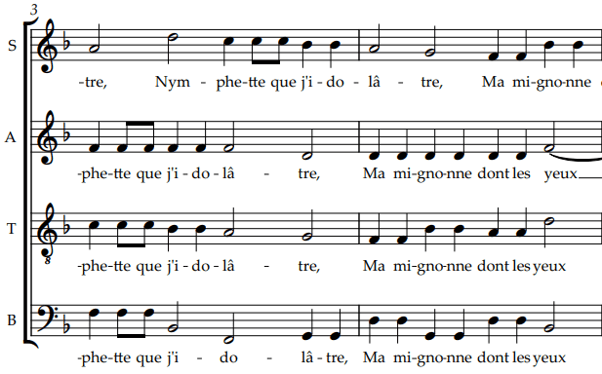
The way we decide to cut multi-syllabic words does not follow the French rules of word-cutting but is based on practicality of singing.
Double consonants:
French rule: cut in the middle.
don-ne gar-rot
Our choice: cut before the consonants, so that the sung syllable is totally under the note.
do-nne ga-rrot
Several consonants:
French rule: cut between consonants.
puis-que mal-heur pour-quoi cap-tive mignar-de
Our choice: attach the second consonant to the following syllable, to avoid “singing” on consonants.
pui-sque ma-lheur pou-rquoi ca-ptive migna-rde
Words ending with E followed by a word starting with a vowel
When a final E is followed by a word starting with a vowel, the E is dropped so that the last syllable of the first word is tied to the beginning of the next.
Example: ‘ingrate alors’.
In scores for French-speaking singers, it would simply be written as above and people would automatically tie both words, which would sound like IN-GRA-TA-LOR.
In our scores, we indicate this in this way to help you: ingrate-alors.