Chanteclair Editions
Learning Aids
When you purchase our PDF scores, you will automatically receive the following audio resources:
- Each vocal part highlighted with the rest of the choir in the background, helping your singers learn their own line.
- Each vocal part removed from the choir texture, allowing your choir singers to practise singing their part within the full choral context.
- For French-language pieces, a recording of the text spoken by a native French speaker to assist with pronunciation and diction.
In addition to the above, here is a general guide to pronouncing French from written modern French.
R
In modern French, R is a guttural sound (coming from the throat) which is difficult to pronounce for non-French people. However, in operas and old-fashioned chansons and songs (like Maurice Chevalier), R is rolled (with the tongue). For the Renaissance repertoire, use the rolled R, especially as it was the standard pronunciation at the time.
FINAL E
Final E (pronounced UH as in Milieu) - which in spoken French is normally not sounded (silent E) – is normally sounded in (old) poetry and songs.
Example: petite nymphe folâtre.
NASAL SOUNDS
The French language is full of nasal sounds such as AN – ON – IN that are spelled in various ways (AN / AM - EN / EM - ON / OM – IN / IM / UN / UM / YN / YM)
Practice these French words used in English to learn how to pronounce them: Croissant – Flambé - Genre - Bonjour - Gratin – Tatin.
SOME LETTER COMBINATIONS
- PH is pronounced like F (Éléphant)
- TH is pronounced like T, i.e. disregard the H – e.g. Théâtre, Thème, Théorie (the English TH sounds as in THE and THICK do not exist in French)
- QU is pronounced like K (not QW like in Latin) - QUE is pronounced KUH as in Musique
- GU+vowel is pronounced like a hard G as in Guitare, not like GW; disregard the U
GN
This combination is pronounced NY. Example: Mignonne: MI-NYO-NNE – Montagne - Champagne
ET
It means ‘AND’ and is always pronounced EH (no T is sounded like in Latin ‘et’)
DOUBLE CONSONANTS+E endings
They make the syllable ‘bouncy’ e.g.:
- -ETTE is pronounced like -ET in PROPHET (also, like ALOUETTE in the French-Canadian traditional song)
- -ESSE is pronounced like the letter ‘S’ (CESSE is pronounced CEH-SS-E)
EZ ending
This recording covers both EZ ending and DIPHTHONGS.
It is pronounced ÉH – VOULEZ.
DIPHTHONGS
Unlike English, French has very few diphthongs, like AI – OU – EY – OY etc.
So Voulez is not VOOLEY but VOOLEH. Plateau is not PLATOU but PLATOH.
U sound
To pronounce the French U, say: “ee”; keep the same tongue position, then round your lips like for “oo” 👉 That’s the real French U.
VOWEL COMBINATIONS
- AI / EI are pronounced EH as in: Fait accompli
- AU / EAU are pronounced OH as in: Plateau
- OI or OIE are pronounced WAH as in: Moi – Foie gras
- OU or OUE are pronounced OO as in: Soupe – Tour (de France)
- EU is pronounced UH as in: Milieu
The combination ŒU is rare but is used in CŒUR (heart) which is a common word in the repertoire. It is pronounced like EU with a hard K at the beginning: K-UH-R.
NOTE regarding OI or OIE: in old French, this vowel combination was pronounced WEH and not WAH like in modern French. You can hear this pronunciation in some French recordings with a focus on ‘authentic pronunciation’ (e.g. by Ensemble Clément Janequin). Thus, MOI was pronounced MWEH, FRANÇOIS was pronounced FRANÇWEH (with the rolled R), etc… You can still hear this pronunciation in some rural parts of France or in Quebec.
FINAL CONSONANTS
They are rarely pronounced.
- DONT is pronounced DON
- LES is pronounced LEH
- YEUX is pronounced YUH
- MIEUX is pronounced MIUH
- DOIS is pronounced DWAH
- FOIS is pronounced FWAH
- SANS is pronounced SANH
- PLUS is pronounced PLU (French U)
- DOUX is pronounced DOOH
SINGLE S IN THE MIDDLE OF A WORD
Sounds like Z if between 2 vowel sounds: APAISER – OISEAU – VASE – LIAISON - MUSIQUE
Else, sounds like S: PISTON – RÉPONSE
FINAL R
Sometimes pronounced: JOUR - AMOUR
Sometimes not pronounced (i.e. ER sounded as EH): APAISER, BAISER
FINAL -ENT
Not pronounced: When it’s a conjugated verb (action word) – the NT ending reflects the Latin construction of the ‘they’ form (e.g. SUNT, CLAMANT) that French has kept in writing but is dropped when speaking. E.g. ‘they leave’ is spelled like this ILS PARTENT but is pronounced IL PARTE.
Pronounced as ANH (i.e. without sounding the final T): When it’s an adverb ending in -MENT (like -LY finishes many English adverbs) e.g. VRAIMENT (really), FACILEMENT (easily), SECRÈTEMENT (secretly), Or when it’s a noun or an adjective, e.g. TOURMENT (pain, torment), ARGENT (silver or money), DIFFÉRENT (different), etc
DANGEROUS LIAISONS
The ideal French words and sentences would comprise of an unending series of: consonant + vowel sounds
As this is impossible due to the structure of words, you sometimes come across several consonant sounds in a row. However, the clash of two vowel sounds following each other is a cardinal sin to the French ear because it breaks the flow of delivery.
To remedy this, the French language uses 2 methods:
- The addition of external consonants (called ‘euphoniques’ i.e. ‘nice sound’) – for example the statement phrase IL Y A (there is) becomes Y A-T-IL as a question both written and spoken, to avoid the clash of A and IL.
- The use of natural ‘ties’ (called LIAISONS in French) between words, using existing silent final letters of the first word. Examples:
- LES YEUX becomes LEH ZYEU where the S becomes Z
- MON PIS ET becomes MON PI ZEH.
- MON ÉTÉ becomes MONH NÉTÉ.
- FORT ENNUYEUX becomes FOR TANH-NUI-YEU.
- DOUX ET becomes DOOH ZEH.
There are exceptions where no method is possible and there are some vowel-vowel clashes.
Also, in everyday spoken French (vs in old poetry or songs) not all ‘liaisons’ are done. For example, FORT ENNUYEUX above where the ‘T’ is sounded, would not be pronounced this way in everyday spoken French because the ‘R’ would be used to tie both words instead of the ‘T’ (FOR ANH-NUI-YEU)– it is a question of language ‘standard’. In poetry the standard is higher than in everyday spoken language. Knowing which standard to use only comes by living in France!
A ‘liaison’ is not done when there is a natural break in the spoken delivery (e.g. between the end of a verse and the beginning of the next) or in singing when there is an in-breath between two words. Example: Puis donc que la nuit me vaut mieux Et que je n’ai bien que par songe. MIEUX and ET are not tied here.
FINAL E FOLLOWED BY A VOWEL
When a final silent E is followed by a word starting with a vowel, the E is dropped so that the last syllable of the first word is tied to the beginning of the next. In Chanteclair Editions scores, we indicate this in this way to help you (example): Ingrate-alors which will sound like IN-GRA-TA-LOR
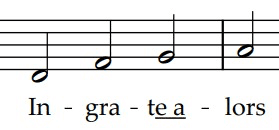
In scores for French-speaking singers, it would simply be written Ingrate alors and French people would automatically tie both words