FAQ
Frequently asked questions
Everything you need to know about buying, downloading, and using our editions. Can’t find your answer? We’re happy to help.
Repertoire
Early music is not very difficult to sing in terms of the ‘notes’: there are no extreme ranges or awkward intervals, and the melismas* generally follow regular ascending or descending patterns. Dissonance is rare and when it occurs, it is transient.
The main difficulty (or interest!) is that the voices do not enter together. The ‘polyphonic’ aspect is somewhat like a fugue, with the different voices entering and leaving independently.
If you are new to this repertoire, we suggest starting with some homophonic pieces to get used to the style of the music before tackling a short polyphonic piece (see ‘Our choir is new to this repertoire – what do you suggest we sing?’)
Even in homophonic pieces where the melody is sung by the sopranos, the other voices have a more interesting role than in modern harmonised songs, where altos and tenors in particular can sometimes feel as though they are merely filling in the gaps.
(*melisma: a group of notes sung to a single syllable of text)
Start with a homophonic piece to get used to the Renaissance style and the French language:
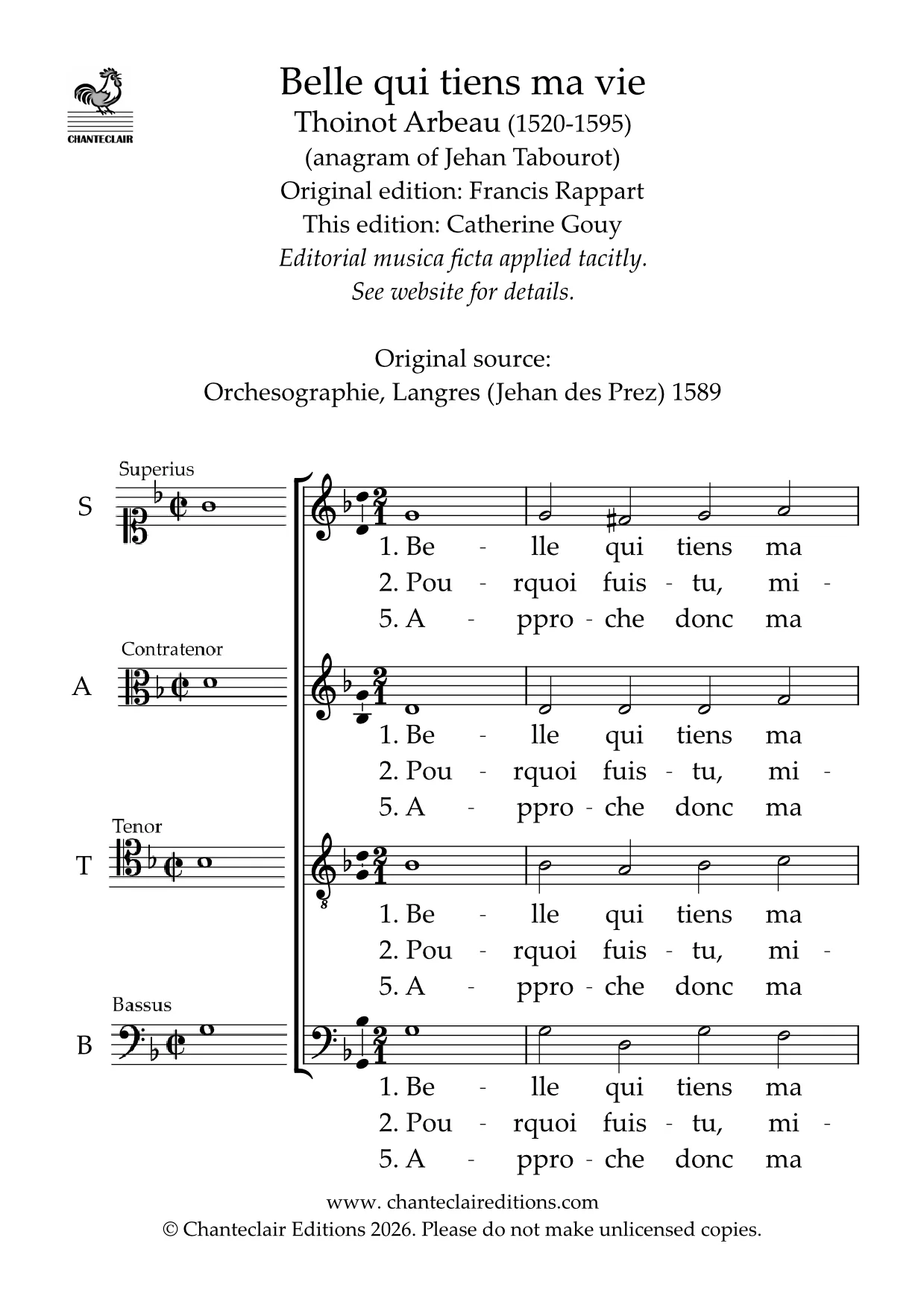
- Belle qui tiens ma vie (Thoinot Arbeau) - there is no need to sing all seven verses!
- Tant que vivrai (Claudin de Sermisy) - mostly homophonic with only six bars at the end in polyphony, a well-known and beautiful piece.
- Tourdion is a fun piece in which the sopranos sing the melody while the other voices mark the rhythm with slightly different lyrics. You can make the song last as long as you like by introducing the different voices one by one starting with the basses, then adding the tenors, altos and sopranos. You can also highlight each voice by having the other voices hum or sing pianissimo. Just experiment and have fun!
Then you can try a slow, short and well-known polyphonic piece:
- Mille regrets (Josquin des Prés)
- Au joli bois (Claudin de Sermisy)
- Jouissance vous donnerai (Claudin de Sermisy)
Absolutely. If you have a particular piece in mind, please email us the details of the piece, and we will see if we can find an original source for it. If we can source it, we can transcribe it and include it in our catalogue.
You can find expert information here:
3 pages: https://simoncarrington.com/wp/wp-content/uploads/carrington_singing_renaissance_music.pdf
A whole book! https://www.examenapium.it/cs/biblio/Kite2007.pdf
If you are interested in early music conducting and performing workshops, please contact us.
Absolutely. By adapting the music to your choir, you would have a very Renaissance approach to performance. There was no fixed ‘pitch’ at the time (like there was no fixed ‘spelling’) therefore pieces were transposed up or down according to who or what was available (singers and/or instruments).
“The most important consideration of pitch is the most sensible solution: the Renaissance made no attempt to standardize pitch and was not overly concerned with it. The primary concern was the creation of a clear and comfortable tone suitable to the Renaissance ideal of an admirable text expressed musically. Allowing ourselves the same freedom of a comfortable pitch, suitable to the voices at hand, will bring us close to the Renaissance attitude of practical performance.”
Lawrence E. Tagg, University of Drayton, 1965
Full article available here: https://ecommons.udayton.edu/cgi/viewcontent.cgi?article=1020&context=udr
Our editions
Some (but not all) of the versions in our ‘Listen’ videos may be slightly different from our editions, either in the text, the music, or both.
The musical differences are mainly due to musica ficta editorial choices; please read the information in the ‘Musica ficta’ tab. Some performers also add a few embellishments, and repeats are sometimes added. This is entirely consistent with the way Renaissance musicians approached performance: there was considerable room for variation and adaptation to the available singers and instruments.
The key in the ‘Listen’ videos is not always the same as in our editions; this information is indicated in the Description of each score.
Textual differences do exist; please read our blog article, “Spelling and textual variation in 16th century sources”.
On the other hand, French in the 16th century was not pronounced exactly as it is today. Please read ‘Vowel combinations’ in the ‘French Pronunciation Guide’ in our ‘Learning Aids’ tab.
Yes, the music itself is now in the public domain, and some editions (though not all) are available online free of charge. However, there are important differences between simply finding a free PDF online and using one of our editions:
• many freely available PDFs do not clearly identify their source, so it can be difficult to assess how closely the transcription follows the original composition;
• they do not include learning tracks for individual voices;
• they generally do not provide an English translation of the lyrics.
With our editions:
• the transcription is made directly from the original source, whether a manuscript or printed source from the 16th or 17th century;
• the source used for the edition is clearly identified;
• the transcription is prepared by a professional early-music editor with decades of experience;
• you receive learning tracks to help your singers learn their individual parts, including French pronunciation where applicable;
• an English translation of the lyrics is provided;
• some of our scores are available in large print.
In other words, you are not paying for the music itself. You are paying for the research, professional transcription, editorial work and practical resources that make this music easier to learn and perform.
The scores are performing editions but they are prepared with scholarly accuracy.
Apart from musica ficta accidentals which are included silently in the majority of scores (see the 'Musica Ficta' tab for more details), all the other information included in the scores are of a scholarly standard:
Named original source and date
Name of the editors
Incipit (original clefs and time signature)
English translation for scores in foreign languages.
Also, please get to know our main music editor, Francis Rappart, by reading his biography and credentials in 'About - Who are we?'.
This is an A4 page of one of our large print scores.
Ordering
Your scores will be immediately available in your account, under 'Downloads'. Just click on the Download button in front of the name of the score, and your personalised PDF will download onto your computer.
Each PDF will be personalised with the following watermark at the top of each page: name of your choir - date of purchase - town of your choir - number of copies purchased.
When the number of copies needed falls between multiples of 5, choose the quantity immediately below the number you need. For example: if you need 17 copies, order 15; if you need 24 copies, order 20; if you need 39 copies, order 35; etc. You will see a message pointing out that the number of copies ordered is less than your number of singers: just ignore it.
You may also choose to buy the multiple of 5 immediately above your present needs if you welcome new singers regularly.
All the files including the singing learning aids will be available in your Account under 'Downloads' but you choose which ones you want to download onto your computer.
If you change your mind later, the files will always be in your Account, ready to be downloaded.
All payments are processed by Stripe. We do not keep a record of your credit card details.
Your account
In some countries, this information is mandatory even for digital downloads, therefore we have included it.
On the other hand, in the future we might also sell paper versions of some scores.
Copyright & practical use
Yes of course, the watermarked PDFs and the learning aid MP3s are for sharing with members of your choir.
If you have a 'Members only' section in your choir website, you can also include the files there; but please only do this if that section is protected by a password only known to your choir members.
Do not include any of our files in public pages of your choir website, although you can of course mention Chanteclair Editions!
Yes, if you have a 'Members only' section in your choir website, please include the files there if that section is protected by a password only known to your choir members.
Do not include any of our files in public pages of your choir website, although you can of course mention Chanteclair Editions!
No. If the total number of singers is roughly the same (new members replacing leaving members), you do not need to buy more scores.
You can share the files with the singers who have joined your choir since you first sang the piece. Treat the PDF like a hard copy that would be passed between singers.
If the total number of singers is much higher than originally (more than 30%), please buy additional copies; they will be added to your original order.
Still need help?
If your question is not answered here, send us a message, we read every one personally and will reply as soon as we can.
No question too small
“If something here did not answer your question, write to us, your message reaches someone who sings this repertoire too.”
Image: The Ghent Altarpiece, panel The Singing Angels, by Jan van Eyck & Hubert van Eyck; collection Sint-Baafskathedraal Gent, artinflanders.be, photo: Hugo Maertens, License Contractuele beperkingen.